7 AI Tools for Data Analytics in 2025: Revolutionizing Business Intelligence
The landscape of data analytics has undergone a transformative shift in 2025, with AI tools for data analytics 2025 emerging as the cornerstone of modern business intelligence. Organizations worldwide are leveraging these advanced platforms to unlock unprecedented insights from massive datasets, driving strategic decision-making and operational excellence. The integration of machine learning algorithms with traditional analytics platforms has created a new paradigm where predictive analytics software and AI-powered data platforms work seamlessly together.
In today’s data-driven economy, businesses generate exponentially more information than ever before. As data volumes exponentially increase, the demand for efficient and intelligent analysis tools has skyrocketed. This surge has catalyzed the development of sophisticated AI tools for data analysis that can process structured and unstructured data with remarkable efficiency. From AI big data solutions to specialized analytics automation tools, the market offers diverse options for organizations seeking to harness the power of artificial intelligence in their data operations.
The evolution of AI in data analytics represents more than just technological advancement—it’s a fundamental shift in how organizations approach data-driven decision making. Using artificial intelligence and machine learning algorithms, they can identify patterns, spot inconsistencies, predict trends, and deliver insights that lead to a better understanding of your business across all functions. This comprehensive guide explores seven cutting-edge AI tools that are revolutionizing data analytics in 2025, each offering unique capabilities to transform how businesses analyze, interpret, and act upon their data. This guide explores seven cutting-edge AI tools for data analytics 2025 that are revolutionizing how businesses analyze and act on their data.
1. PowerDrill AI: Conversational Data Analysis Platform
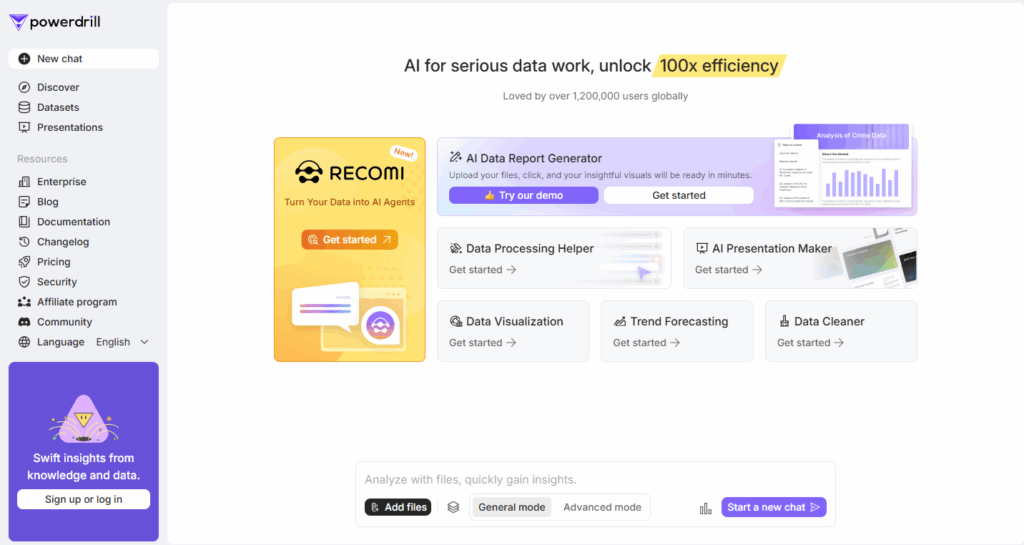
Among the most intuitive AI tools for data analytics 2025, PowerDrill AI stands out PowerDrill AI stands out as a revolutionary AI data analysis tool that transforms how organizations interact with their data through natural language processing. This innovative platform enables users to upload datasets and engage in conversational analytics, making complex data analysis accessible to non-technical users. PowerDrill AI is a powerful platform for fast and efficient data analysis, enabling users to upload files and interact with their data through a conversational interface.
The platform excels in providing AI for business intelligence through its sophisticated natural language querying capabilities. Users can ask questions about their data in plain English, and the AI data analyzer interprets these queries to generate comprehensive insights, visualizations, and reports. This approach democratizes data analysis, allowing business stakeholders to perform quantitative analysis AI without requiring extensive technical expertise.
PowerDrill AI’s strength lies in its ability to handle multiple data formats and provide real-time analytics automation. The platform supports various file types, from CSV and Excel files to complex databases, making it an ideal AI tool for data analysis across diverse industries. Its machine learning analytics capabilities enable users to identify trends, anomalies, and patterns that might be missed through traditional analysis methods.
For organizations seeking free AI tools for data analysis, PowerDrill AI offers tiered pricing options that cater to different business needs. The platform’s AI statistical analysis features include predictive modeling, regression analysis, and clustering algorithms, making it suitable for both basic data exploration and advanced statistical analysis. Its user-friendly interface and powerful AI analytics tools make it an excellent choice for businesses looking to implement AI in data analytics without extensive infrastructure changes.
2. Tableau: AI-Enhanced Data Visualization Leader
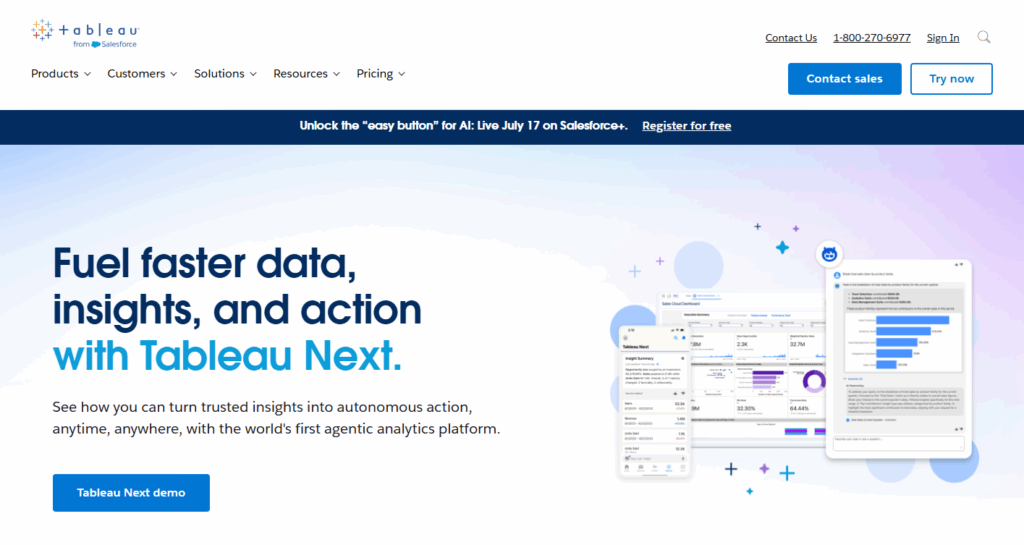
Tableau continues to dominate the data visualization landscape in 2025, having evolved into a comprehensive AI-powered data platform that seamlessly integrates artificial intelligence with traditional business intelligence capabilities. Even the most advanced data intelligence platforms like Domo, Tableau, or Power BI use AI tools to enhance user experiences, surface more insights, and ensure users find answers to their business questions. The platform’s AI integration has transformed it from a visualization tool into a complete analytics and ai solution.
For companies that prioritize data visualization, Tableau is one of the best AI tools for data analytics 2025 The latest version of Tableau incorporates advanced AI for data science capabilities, including automated insight generation, natural language query processing, and predictive analytics features. These enhancements make Tableau one of the best AI tools for data analysis, particularly for organizations that prioritize visual storytelling and interactive dashboards. The platform’s AI data tools automatically suggest visualizations, identify outliers, and provide contextual insights that help analysts focus on the most critical aspects of their data.
Tableau’s AI analytics tools excel in handling large datasets and providing real-time analytics across multiple data sources. The platform’s machine learning integration enables users to build predictive models directly within the visualization environment, making it an ideal choice for businesses seeking comprehensive AI big data solutions. Its ability to process both structured and unstructured data makes it suitable for diverse analytical use cases, from financial modeling to customer behavior analysis.
For organizations implementing AI platforms for data analysis, Tableau offers enterprise-grade security, scalability, and collaboration features. The platform’s AI-enhanced capabilities include automated data preparation, intelligent recommendations, and advanced statistical analysis tools. These features position Tableau as a leading choice for businesses seeking to combine traditional business intelligence with cutting-edge AI data analysis capabilities.
3. IBM Watson Analytics: Enterprise AI Intelligence
IBM Watson Analytics represents the pinnacle of enterprise-grade AI for data analytics, offering a comprehensive suite of artificial intelligence capabilities designed for large-scale data processing and analysis. As one of the most established AI analytics platforms, Watson Analytics provides organizations with robust AI tools for data analysis that leverage IBM’s decades of experience in artificial intelligence and machine learning.
The platform’s strength lies in its ability to process vast amounts of both structured and unstructured data, making it an ideal solution for enterprises dealing with complex data ecosystems. Watson Analytics incorporates advanced natural language processing capabilities, enabling users to query their data using conversational interfaces. This feature makes it accessible to business users while providing data scientists with powerful AI statistical analysis tools for advanced modeling and prediction.
Watson Analytics excels in predictive analytics software capabilities, offering sophisticated machine learning algorithms that can identify patterns, predict trends, and generate actionable insights. The platform’s AI for business intelligence features include automated report generation, anomaly detection, and risk assessment tools that help organizations make data-driven decisions with confidence. Its integration with other IBM cloud services provides seamless scalability and enterprise-grade security.
For organizations seeking comprehensive AI data analytics tools, Watson Analytics offers industry-specific solutions tailored to healthcare, finance, retail, and manufacturing sectors. The platform’s AI-powered data analysis capabilities include sentiment analysis, fraud detection, and customer behavior modeling. These specialized features make Watson Analytics particularly valuable for enterprises requiring domain-specific AI analytics solutions that can handle complex regulatory requirements and industry standards.
4. H2O.ai: Open-Source Machine Learning Platform
H2O.ai has emerged as a leading open-source AI platform for data analysis, offering democratized access to advanced machine learning capabilities without the traditional barriers of enterprise software licensing. This innovative platform provides organizations with powerful AI tools for data analytics that rival proprietary solutions while maintaining the flexibility and transparency of open-source development.
As open-source solutions gain traction, H2O.ai emerges as a leading choice among AI tools for data analytics 2025. The platform’s core strength lies in its automated machine learning (AutoML) capabilities, which enable users to build sophisticated predictive models without extensive data science expertise. H2O.ai’s AI for data analysis features include automated feature engineering, model selection, and hyperparameter tuning, making it accessible to analysts with varying levels of technical expertise. These capabilities position it as one of the best AI tools for data analysis in the open-source ecosystem.
H2O.ai excels in handling large-scale data processing and provides exceptional performance for AI big data solutions. The platform’s distributed computing architecture enables organizations to process massive datasets efficiently, while its AI analytics tools provide real-time insights and predictions. Its support for multiple programming languages, including Python, R, and Java, makes it versatile for different development environments and technical preferences.
For organizations implementing AI in data analytics on a budget, H2O.ai offers a compelling value proposition with its free community edition and enterprise support options. The platform’s AI data analysis capabilities include time series forecasting, anomaly detection, and natural language processing, making it suitable for diverse analytical applications. Its integration with popular data science tools and cloud platforms provides flexibility for organizations with existing technical infrastructure.
5. DataRobot: Automated Machine Learning Excellence
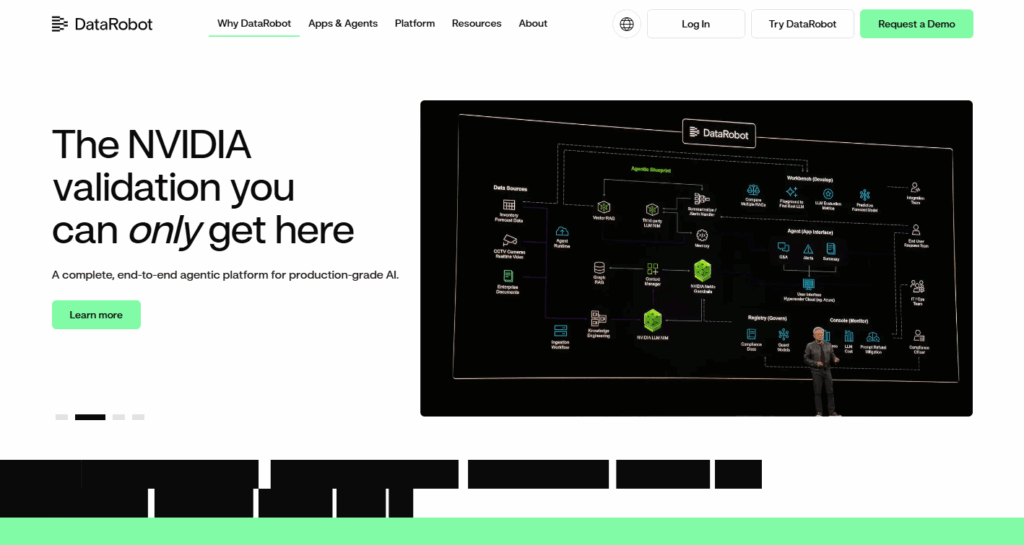
DataRobot has established itself as a pioneer in automated machine learning, providing organizations with sophisticated AI tools for data analysis that streamline the entire machine learning lifecycle. The platform’s approach to AI for data analytics emphasizes automation, enabling data scientists and analysts to build, deploy, and maintain predictive models with unprecedented efficiency and accuracy.
DataRobot has become one of the most scalable and explainable AI tools for data analytics 2025 for enterprise use. The platform’s automated machine learning capabilities encompass the entire data science workflow, from data preparation and feature engineering to model selection and deployment. DataRobot’s AI analytics tools automatically test hundreds of machine learning algorithms to identify the best-performing models for specific datasets and use cases. This comprehensive approach makes it one of the most effective AI data analysis tools for organizations seeking to scale their analytical capabilities.
DataRobot’s strength in AI for business intelligence lies in its ability to provide interpretable and explainable AI models. The platform includes advanced model interpretation tools that help users understand how predictions are made, ensuring transparency and regulatory compliance. These features are particularly valuable for organizations in regulated industries that require explainable AI for data science applications.
For enterprises seeking comprehensive AI platforms for data analysis, DataRobot offers end-to-end MLOps capabilities that support the entire machine learning lifecycle. The platform’s AI-powered data analysis features include automated model monitoring, drift detection, and retraining capabilities that ensure models remain accurate over time. Its integration with popular business intelligence tools and cloud platforms makes it suitable for organizations with diverse technical environments.
6. Google Cloud AutoML: Scalable AI Analytics
Google Cloud AutoML represents Google’s commitment to democratizing artificial intelligence through accessible and scalable AI tools for data analysis. This cloud-native platform leverages Google’s expertise in machine learning and artificial intelligence to provide organizations with powerful AI analytics capabilities that can handle datasets of any size and complexity.
The platform’s strength lies in its seamless integration with Google Cloud’s ecosystem of data services, providing organizations with comprehensive AI big data solutions. Google Cloud AutoML’s AI for data analytics capabilities include automated model training, hyperparameter optimization, and deployment automation, making it accessible to users with varying levels of machine learning expertise. Its natural language processing and computer vision capabilities extend its utility beyond traditional structured data analysis.
Google Cloud AutoML excels in providing AI for business intelligence through its integration with Google’s business intelligence tools and data warehousing solutions. The platform’s AI data analysis capabilities include real-time prediction serving, batch processing, and streaming analytics that enable organizations to implement AI in data analytics across their operations. Its global infrastructure ensures low-latency performance and high availability for mission-critical applications.
For organizations implementing AI platforms for data analysis at scale, Google Cloud AutoML offers enterprise-grade security, compliance, and governance features. The platform’s AI analytics tools include automated model monitoring, performance tracking, and bias detection capabilities that ensure responsible AI deployment. Its pay-as-you-go pricing model and integration with popular development tools make it accessible to organizations of all sizes.
7. Microsoft Azure Machine Learning: Enterprise AI Integration
Microsoft Azure Machine Learning has evolved into a comprehensive AI platform that seamlessly integrates with Microsoft’s ecosystem of business applications and productivity tools. This integration makes it one of the most accessible AI tools for data analysis for organizations already invested in Microsoft technologies, providing a familiar environment for implementing AI in data analytics.
The platform’s strength lies in its end-to-end machine learning capabilities, from data preparation and model development to deployment and monitoring. Azure Machine Learning’s AI for data analytics features include automated machine learning, custom model development, and MLOps capabilities that support the entire machine learning lifecycle. Its integration with Microsoft Office applications and Power BI makes it particularly valuable for organizations seeking to embed AI analytics tools directly into their business workflows.
Azure Machine Learning excels in providing AI for business intelligence through its seamless integration with Microsoft’s business intelligence stack. The platform’s AI data analysis capabilities include predictive analytics, anomaly detection, and natural language processing that can be easily incorporated into existing business applications. Its support for multiple programming languages and frameworks provides flexibility for diverse development teams.
For enterprises seeking comprehensive AI platforms for data analysis, Azure Machine Learning offers enterprise-grade security, compliance, and governance features. The platform’s AI analytics capabilities include automated model monitoring, performance tracking, and responsible AI features that ensure ethical and compliant AI deployment. Its integration with Microsoft’s broader ecosystem of business applications makes it an ideal choice for organizations seeking to implement AI big data solutions within their existing technology infrastructure.
Comprehensive Comparison: Features, Pricing, and Capabilities
| Tool | Key Features | Pricing Model | Industries Served | Analytics Capabilities |
| PowerDrill AI | Conversational interface, multi-format support, real-time analytics | Freemium/Tiered | All industries | Predictive modeling, statistical analysis, trend identification |
| Tableau | AI-enhanced visualization, automated insights, natural language queries | Subscription-based | All industries | Advanced visualization, predictive analytics, real-time dashboards |
| IBM Watson Analytics | Enterprise AI, NLP, industry-specific solutions | Enterprise licensing | Healthcare, finance, retail, manufacturing | Sentiment analysis, fraud detection, risk assessment |
| H2O.ai | Open-source AutoML, distributed computing, multi-language support | Free community/Enterprise support | All industries | Time series forecasting, anomaly detection, NLP |
| DataRobot | Automated ML lifecycle, explainable AI, MLOps | Enterprise subscription | Regulated industries, enterprise | Automated model building, interpretable AI, model monitoring |
| Google Cloud AutoML | Cloud-native, scalable infrastructure, integrated ecosystem | Pay-as-you-go | All industries | Real-time predictions, batch processing, streaming analytics |
| Azure Machine Learning | Microsoft ecosystem integration, end-to-end ML, Office integration | Azure subscription | Microsoft-centric organizations | Predictive analytics, anomaly detection, business app integration |
Frequently Asked Questions
What makes AI tools for data analytics different from traditional analytics software?
AI tools for data analysis differ fundamentally from traditional analytics software in their ability to automatically identify patterns, generate insights, and make predictions without explicit programming. While traditional software requires users to define specific queries and analysis parameters, AI analytics tools use machine learning algorithms to discover hidden relationships in data and provide automated insights. These AI-powered data platforms can process both structured and unstructured data, adapt to new patterns, and provide predictive capabilities that traditional tools cannot match.
How do I choose the best AI tool for data analysis for my organization?
Selecting the best AI tool for data analysis depends on several factors including your organization’s size, technical expertise, data complexity, and specific use cases. Consider whether you need AI for business intelligence, specialized industry applications, or general-purpose analytics. Evaluate factors such as ease of use, integration capabilities with existing systems, scalability, and pricing models. For organizations with limited technical resources, platforms like PowerDrill AI or Google Cloud AutoML offer user-friendly interfaces, while enterprises may benefit from comprehensive solutions like IBM Watson Analytics or DataRobot.
Are there free AI tools for data analysis available?
Yes, several AI tools for data analytics offer free versions or open-source alternatives. H2O.ai provides a robust free community edition with comprehensive machine learning capabilities. Many platforms, including PowerDrill AI and Google Cloud AutoML, offer freemium models with limited usage tiers. Additionally, cloud providers often provide free credits for new users to explore their AI platforms for data analysis. These free options allow organizations to experiment with AI in data analytics before committing to paid solutions.
How can AI improve my existing data analysis processes?
AI can significantly enhance existing data analysis processes through automation, pattern recognition, and predictive capabilities. AI analytics tools can automatically clean and prepare data, identify anomalies, and generate insights that might be missed through manual analysis. These tools can process larger datasets more efficiently, provide real-time analytics, and offer predictive modeling capabilities that help organizations anticipate future trends. AI for data science can also democratize analytics by making complex analysis accessible to non-technical users through natural language interfaces.
What industries benefit most from AI data analytics tools?
While AI tools for data analysis benefit virtually all industries, certain sectors see particularly significant advantages. Healthcare organizations use AI for clinical decision support and patient outcome prediction. Financial services leverage AI analytics for fraud detection and risk assessment. Retail businesses implement AI for customer behavior analysis and demand forecasting. Manufacturing companies use AI for predictive maintenance and quality control. Technology companies utilize AI for product optimization and user experience enhancement. The versatility of modern AI platforms for data analysis makes them valuable across diverse industry verticals.
How do AI analytics tools handle data privacy and security?
Modern AI analytics tools prioritize data privacy and security through multiple layers of protection. Enterprise-grade platforms like IBM Watson Analytics and Microsoft Azure Machine Learning provide comprehensive security features including encryption, access controls, and audit trails. These tools often comply with regulations such as GDPR, HIPAA, and SOC 2. Many AI platforms for data analysis offer on-premises deployment options for organizations with strict data sovereignty requirements. Additionally, features like differential privacy and federated learning enable organizations to gain insights while maintaining data privacy.
What technical skills are required to use AI tools for data analysis?
The technical skills required vary significantly depending on the chosen AI tool for data analysis. Platforms like PowerDrill AI and Tableau are designed for business users and require minimal technical expertise, offering natural language interfaces and drag-and-drop functionality. More advanced platforms like H2O.ai and DataRobot may require some understanding of machine learning concepts and statistical analysis. For organizations implementing comprehensive AI big data solutions, having team members with data science, machine learning, and cloud computing skills is beneficial. However, many modern AI analytics tools are designed to be accessible to users across different technical skill levels.
How can I measure the ROI of implementing AI data analytics tools?
Measuring ROI for AI tools for data analysis involves evaluating both quantitative and qualitative benefits. Quantitative metrics include time savings from automated analysis, improved accuracy of predictions, faster decision-making, and cost reductions from optimized operations. Qualitative benefits include enhanced decision-making capabilities, improved customer satisfaction, and competitive advantages from better insights. Organizations should establish baseline metrics before implementation and track improvements in key performance indicators such as analysis time, prediction accuracy, and business outcomes. The specific ROI will depend on your organization’s use cases and the chosen AI platform for data analysis.
The Future of AI in Data Analytics: Looking Ahead
The future of AI in data analytics promises even more transformative changes as we progress through 2025 and beyond. AI employs machine learning algorithms and advanced techniques to process both structured and unstructured data, predict future trends, and offer actionable insights. The convergence of artificial intelligence with traditional business intelligence is creating new possibilities for organizations to harness their data assets more effectively than ever before.
Emerging trends in AI for data analytics include the rise of augmented analytics, where AI automatically generates insights and recommendations, reducing the need for manual data exploration. Natural language processing capabilities are becoming more sophisticated, enabling more intuitive interactions between users and their data. The integration of AI with Internet of Things (IoT) devices and edge computing is enabling real-time analytics at unprecedented scales, making AI big data solutions more accessible and powerful.
The democratization of AI tools for data analysis continues to accelerate, with platforms becoming more user-friendly and accessible to non-technical users. This trend is particularly evident in the development of conversational AI interfaces and automated machine learning capabilities that reduce the barrier to entry for organizations seeking to implement AI in data analytics. As these tools become more sophisticated and affordable, we can expect to see broader adoption across industries and organization sizes.
Looking ahead, the evolution of AI analytics tools will likely focus on ethical AI, explainable algorithms, and responsible data usage. Organizations are increasingly recognizing the importance of transparent and accountable AI systems, particularly in regulated industries. The development of AI platforms that provide clear explanations for their recommendations and predictions will become crucial for maintaining trust and compliance in AI-driven decision-making processes.
The integration of AI with emerging technologies such as quantum computing, blockchain, and advanced visualization techniques will further expand the capabilities of data analytics platforms. These technological convergences will enable new forms of analysis and insight generation that are currently impossible with traditional computing approaches. As we move forward, organizations that embrace these AI-powered data platforms will be better positioned to thrive in an increasingly data-driven business environment.
In conclusion, the seven AI tools for data analytics highlighted in this guide represent the current state of the art in artificial intelligence-powered data analysis. Each platform offers unique capabilities and advantages, making them suitable for different organizational needs and use cases. As AI continues to evolve and mature, these tools will become even more powerful and accessible, transforming how organizations approach data analysis and decision-making. The future belongs to organizations that can effectively harness the power of AI for data analytics to drive innovation, efficiency, and competitive advantage in their respective markets.